Physiotherapy on Macquarie

02 9252 5770
reception@ssop.com.au
Level 7, 139 Macquarie Street, Sydney

Physiotherapy on Pitt

02 9264 4153
pittst@ssop.com.au
Suite 1, Level 5, 321 Pitt Street, Sydney
 
Sydney Sports & Orthopaedic Physiotherapy

Welcome to our Blog


At Sydney Sports and Orthopaedic Physiotherapy we want to stay connected. In addition to this website, our Facebook page, our LinkedIn account and our newsletter, we thought that a BLOG would be a great way to share our thoughts on Physiotherapy, Pilates, Common Injuries and other topics of interest.


You can follow your favourite physio here and stay up to date with latest news, trends and thoughts from the accessible and highly trained staff here at Sydney Sports and Orthopaedic Physiotherapy. Enjoy.

‘Quick’ Treatment of Low Back Pain

Low back pain sufferers find relief from early physio treatment

Low back pain affects up to 80% of people at some point in their lives. Pain can range from a short-term dull ache to recurring chronic pain. A recent study by the University of Gothenburg has shown that immediate treatment by a Physiotherapist can reduce problems with recurring low back pain.

The study looked at 60 patients with low back pain. The effect of receiving an examination and treatment within 48 hours was subsequently evaluated compared to being on a waiting list for four weeks before receiving the same treatment.

While the results indicated an improvement after treatment in both groups, the group that had been given early access to an examination and individualised treatment maintained their improvement after six months, whereas the group on the waiting list were more likely to suffer with recurring back pain.

With over half of people suffering from back pain becoming long-term chronic sufferers, often work, everyday and leisure activities are limited to varying degrees. Given that long-term pain often requires extensive and expensive treatment, it is important that the pain be treated at an early stage. The results of this study clearly indicate that early examination and treatment by a Physiotherapist are important for reducing low back pain in the long term.

Source: University of Gothenburg

Posted in Brad McIntosh | Comments Off

Understanding Pain

There is a change in the way that therapists are looking at pain these days.

We now know that people who understand pain are much more able to deal with pain. Especially people who have suffered with pain for a long time.

Sometimes pain can become such a constant companion that it can be difficult to see past it, which can have a significant effect on a persons psyche.

I would recommend everyone to watch this youtube video. It spends 5 minutes explaining pain in an understandable and easily accessible way. Developed by GP Access and the Hunter integrated Pain Service it is a great way to learn more about how to manage pain.

Posted in Stuart Baptist | Tagged , , , , , , , | 1 Comment

Movember

Yes…It’s that time again.
What started as a group of guys from adelaide supporting the RSPCA (the brand logo was ‘growing whiskers for whiskers!!!) has whirlwinded into a global phenomenon.

Every October 31st men across the world shave in preparation for the month of Movember. During this month no razor blade is allowed to touch the skin beneath the nose.
Mo’ Bro’s and their female support crew (Mo’Sistas) then go about getting sponsored to grow facial hair for the whole month and will get sponsored for maintaing their facial hair in any way they see fit.
Apart from the fun and games though there is a serious side. 77,870 people across Australia have raised $1,494,530 so far for mens health charities including the prostate cancer foundation of australia.
For more info go to the Movember website.
If you can’t or don’t want to grow a mo’, support those around you who can and are.
Happy Movember.

Posted in Stuart Baptist | Tagged , , , , , , | Comments Off

Pregnancy Pilates Classes

Pilates is one of the most effective forms of exercise to use during pregnancy. Many changes occur for women during this exciting time including hormonal changes, weight increase and physical distribution, balance and centre of gravity, postural, muscular and ligamentous changes.
Pilates can help women deal with these changes, possibly avoiding problems both during and post-natally, and assist with the actual birth.
Carrying out a pilates program during pregnancy allows women to strengthen their deep abdominals, maintain and improve their breathing capacity, strengthen their legs to help carry the growing weight of the baby, strengthen the upper body in preparation for carrying and lifting the baby when it arrives and also improve overall endurance during labour. General strength and return to exercise post natally is also strongly aided by maintaining good strength during pregnancy.
After months of supporting a baby, labour and delivery, the abdominals and pelvic floor muscles are likely to have become stressed and stretched, and will need specific attention through physical exercise to activate and regain strength. Current figures report 1 in 3 women will become incontinent following childbirth, due to weak and ineffective pelvic floor muscles. This does not need to be the case when progressive, functional Pilates exercise can address these muscles in any capacity, no matter how weakened and what other conditions exist. However, the sooner you get on top of this the better….don’t say I didn’t warn you!!!
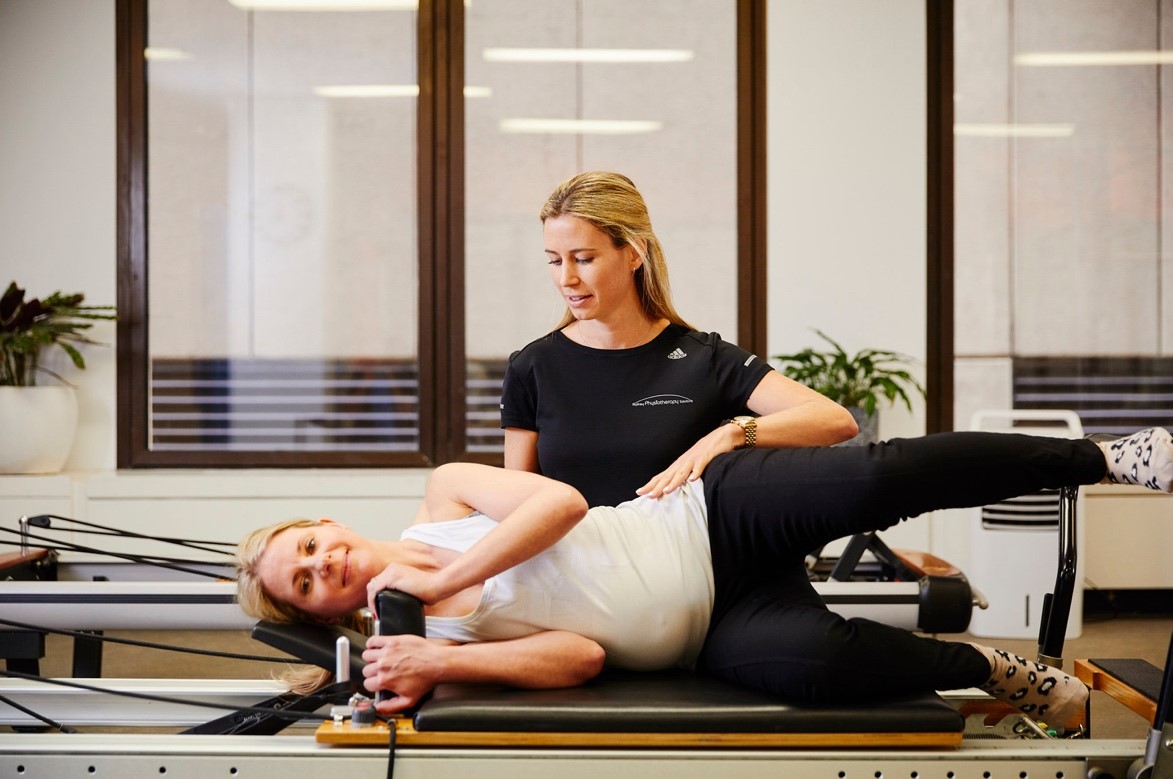
‘Pilates on Macquarie’ caters for Mums-to-be with private and duet pilates classes. After assessment, if considered appropriate, pregnant clients may also join the group classes until the later stages of pregnancy.
Even if you have been diligently carrying out your pelvic floor muscle exercises but are unsure if you are doing them correctly, you can come in for an assessment with the real-time ultrasound, where we can ensure you’re switching on the right muscles and not wasting your time!!
Ailish takes care of the pregnancy pilates at Pilates on Macquarie so if you have any queries, feel free to contact her on 9252 5770 or email at ailishtoomey@ssop.com.au.

Posted in Ailish Toomey, Pilates, Uncategorized | Comments Off

Basic principles of how the rotator cuff works…

The shoulder is a complex joint. It is made up of joints between the arm and shoulder blade, the collar bone and shoulder blade, the shoulder blade and the back and the collar bone and the sternum. It can, and often is, affected by abnormalities and imbalances from structures originating from the base of the skull, chest wall, spine and even the opposite gluteal/buttock muscles. The shoulder joint itself can not work effectively without all these joints and muscles working together. The rotator cuff muscles are only one part of the jigsaw but are very important in maintaining the head of the humerus (top of the upper arm bone) in contact with the glenoid fossa (the socket part of the joint). This allows the shoulder to be very mobile which basically made our lives at the top of the food chain possible! The unfortunate flip side though is that we lose out on stability, because to have this range we need to have a shallow joint surface/cup which needs the rotator cuff to dynamically stabilise its position thus in turn leaving it susceptible to being dislocated.

The figure above shows how the 4 rotator cuff muscles (supraspinatus, infraspinatus, subscapularis and teres minor) attach to the shoulder joint and wrap around the head of the humerus. The force which is produced when the rotator cuff activates, pulls the head of the humerus into the glenoid fossa to make it more stable and also pulls the head downwards to stop it from hitting the acromion process (the bony bit on top of the scapula).  If the capsule around the joint is loose and/or the rotator cuff is weak, the head of the humerus can get pulled out of position slightly and ‘impinge’ on other structures causing tendinitis, bursitis or instability episodes which can cause pain and loss of function.

The take home message here would be, that shoulder pain can be coming from structures in and around the joint itself, but the actual cause can be elsewhere. For any shoulder problems lasting more than a few days a thorough examination should be performed to reduce the likelihood of future complications and more serious shoulder pathology occuring. If you have any problems that need discussing or for us to have a look at, please feel free to contact us on 02 9252 5770 and we’d be happy to help.

Posted in Common Injuries, Geoff Brockenshire, Physiotherapy | Comments Off

The barefoot movement: MBT shoes

Every now and then I am asked the same question: so what do you think about those “insert name of barefoot running shoe here”.

MBT shoes are the original unstable or “barefoot” shoe design, named so after “Masai Barefoot Technology”. The shoe has a rounded sole in the anterior-posterior direction and a cushioned sensor under the heel that creates a degree of instability in both the anterior-posterior and medial-lateral directions. The idea is that this provides some of the benefits attributed to barefoot motion, to help facilitate smaller intrinsic as well as the extrinsic muscles of the foot and ankle to work. This has the potential to assist in reducing joint stress of the foot and ankle and higher, improve balance/posture, and encourage lesser used muscles to work.

There is some anecdotal and scientific research to support and negate the proposed benefits of the MBT shoe, some of which is in peer-reviewed journals; however many are studies conducted by the manufacturers themselves. There is little known of the long-term effect of wearing such a shoe.

So what is my answer?

As with anybody who presents for physiotherapy, the estimated benefit from an MBT shoe must be considered by a case-by-case basis. A person who has reduced stability through foot/ankle, or higher up the limb/pelvis/trunk, in concurrence with a specific injury, may have their problem significantly exacerbated by putting them into a more unstable position. Furthermore, if there is a specific biomechanical fault which is the cause/contributor of the problem (e.g. a pelvic malalignment), changing the footwear won’t correct the problem!

The amount of time of wear of such as shoe needs also to be evaluated. To go from wearing shoes for one’s whole life for activity/sport to wearing an unstable shoe has the potential for stressing structures not used to the reduced support. Monitoring training/wear time in such a situation needs to be considered.

Finally, even in appropriate situations where the shoe may hold some benefit, whether the wear of such a shoe is better than other approaches in the way of exercise, balance/proprioceptive retraining etc. for similar issues, is unknown. It is unlikely to be as specific as targeted exercises/treatment for a complaint.

There certainly many proposed benefits of MBTs in some situations – have a chat to your physio or podiatrist about whether they might be appropriate for you.

Posted in ANKLE AND FOOT, Facebook, Kerry Jacobs, Physiotherapy, Running | Comments Off

Some practical postural tips

Posture….

I may as well have just said blah blah blah…….

Everyone knows about it, everyone feels nagged to do it…..very few actually actively choose to do something about changing/improving it. Don’t stop reading here….read on!!!

An interesting fact is that our postural muscles are our inbuilt marathon runners. They are designed to produce long slow tonic activity right through the day. If you’re feeling discomfort the longer you sit or stand or are achey at the end of a day it may be that your marathon runners are not fit enough! (you have poor postural ENDURANCE).

So how do we train for endurance? We interval train, periods of activity (gradually increasing in length) with rests in between.

It’s unreasonable to ask an out of shape marathon runner to run a marathon to get fit, so it is unreasonable for us to expect to maintain perfect posture throughout the day if our postural muscles are unfit.

Rebooting, or refreshing our postural muscles every hour is the best way to increase the exposure to training time throughout the day in the early stages.

Look at our website for more information on how to achieve better postural positioning and awareness.

And remember….reward yourself when you remember to correct your posture, every time you make a choice to fight gravity you are improving your postural endurance capacity. Don’t get frustrated, it takes time to be able to train for a marathon, it will take time to improve your posture. Your body will thank you though!!

Posted in Common Injuries, Stuart Baptist | Tagged , , , , , | Comments Off

Osteoporosis – what is it and what do I do if I have it?

Osteoporosis is a chronic bone disorder that results in reduced bone density leading to increased risk of fractures. It occurs when the body fails to form enough new bone and when too much old bone is absorbed by the body, or both. Calcium and phosphate are two minerals that are essential for normal bone formation. Throughout youth, your body uses these minerals to produce bones. If you do not get enough calcium, or if your body does not absorb enough calcium from the diet, bone production and bone tissues may suffer.

The leading cause of osteoporosis is a drop in estrogen in women at the age of menopause and a drop in testosterone in men. Some other causes include insufficient intake of calcium and vitamin D in older men and women, a shortage of weight bearing exercises and other age related changes in the human body.

Osteoporosis is a silent condition. There are no symptoms in the early stages of the disease.
Symptoms occurring late in the disease include:
• Bone pain or tenderness
• Fractures with little or no trauma
• Loss of height (as much as 6 inches) over time
• Low back pain due to fractures of the spinal bones
• Neck pain due to fractures of the spinal bones
• Stooped posture or kyphosis, also called a “dowager’s hump”

A bone mineral density test (DEXA scan) can measure how much bone you have. This result can be used to predict your risk for bone fractures in the future.

Now to the important part…..

The key thing to remember is osteoporosis is treatable and fractures are preventable. Lifestyle and diet changes may be recommended in your treatment.
Exercise is key to helping maintain flexibility and balance, reducing your risk of falls and fractures. Exercise is important both as a preventative method and as a risk reduction tool for osteoporosis. A combination of weight-bearing exercise (walking, tennis, dancing), resistance exercise (free weights, stretch bands), and balance exercise (pilates, yoga) is recommended for those at risk of or who have osteoporosis. If you are training with a personal trainer or attending a group class, it is important to let the trainer know if you have osteoporosis so they can ensure you are carrying out the appropriate exercises to improve your bone mineral density.

Following a diet that provides the proper amount of calcium, vitamin D, and protein will also help. While this will not completely stop bone loss, it will guarantee that a supply of the materials the body uses to form and maintain bones is available.

Posted in Ailish Toomey, Pilates, Uncategorized | Comments Off

Good luck to everyone running at the Blackmores Running Festival

A few tips to keep you injury free….

- Warm up before the run. With the vast number of participants attending the event this year it may be a bit of a slow start. Make the most of that to gradually get your legs moving prior to really opening up and running fast. Jogging on the spot before the gun is a good way to get the blood pumping and your body ready to take off. Research has shown that ‘prepping’ your legs for movement can improve your ability to ‘hit the ground running’ (mind the pun) and get you off to a better start.
- Stretch. It’s important to be flexible! Research shows that it doesn’t matter when you stretch (before/after exercise), what’s most important is that you are flexible. So adding a stretching programme to your daily/training routine is important. Gentle static stretches in the days leading up to an event can help you feel less stiff and allow you to feel better for your run.
- Stay hydrated… Drink before during and after the race. Muscles need water to work and remember that feeling thirsty often means that you are already dehydrated! So drink small amounts regularly throughout the race.
- Listen to your body! There is a point where pain does not equal gain. If you are feeling faint, nauseous, dizzy or just quite unwell stop rest and decide whether you can go on… Its a fun run, not the 2000 olympics.
- Rest up in the week/days prior to the run. Fitness gains can’t be made this close to the run so take it easy, eat well and if you really need to run only do a few km’s at a very slow pace just to get the blood pumping. Aim to have your legs/body at 100% for the day rather than then having them be in recovery mode from your last minute training run.
- Finally, have fun! Everyone will be hurting as much as you so take strength from that and keep on going (so long as your body is physically able to do so). Wear your name on your shirt and get pepped up by the spectators that call your name. It sounds corny, but if you make the finish line you’re a winner in my eyes!!

GOOD LUCK!!

If you have any problems on the day come and see us in the Flexagil Tent in the recovery zone once you finish the race… We’ve got free massages to all who sign up as well, so drop on by whether you’re walking, limping, laughing or crying, there’s something for all… Roll in!!

Posted in Uncategorized | 1 Comment

How to Run & Stay Injury Free

Brad reveals the latest preventatives for common running injuries in this article from Body & Soul

Posted in Uncategorized | Comments Off

Sydney Sports & Orthopaedic 	Physiotherapy